A Parent’s Honest Guide to What Works
If you’ve ever wondered whether your child can really learn Arabic online, you’re not alone. After years of remote schooling, many parents are understandably skeptical. Can a language as lively and deeply connected to conversation and culture really be learned through a laptop screen? It’s a fair question. Your child’s time, effort, and your investment should lead to meaningful progress.
Kids can learn Arabic online — but not through just any setup. Success depends on how the lessons are structured, who is teaching, and what happens at home beyond screen time. This guide explains how kids learn Arabic online in practice, what effective instruction looks like, the concerns parents commonly raise, and how to tell if your child is making real progress, whether they’re just starting out or you’re learning Arabic alongside them.
How Kids Learn Arabic Online With the Right Instruction
Language learning has always depended on the same core ingredients: exposure, repetition, and — most importantly — interaction. Children don’t learn to speak simply by listening to words over and over. They learn by using those words, receiving gentle corrections, and hearing language modeled naturally in context. So the real question isn’t whether a screen can replace a classroom or a conversation at home. It’s whether the interaction that drives real learning is still there. When it is, the screen itself matters far less than many parents assume.
Live Interaction vs. Passive Apps
This is where the “really” in “can kids really learn Arabic online?” gets answered. Vocabulary apps with flashcards and cartoon characters can help children recognize and remember new words. For example, a child might match a picture of a cat to the Arabic word “قطة”. But recognition isn’t the same as speaking or understanding Arabic. Real language learning needs a live, responsive teacher who asks questions, waits for an answer, and adjusts the lesson based on what the child says. That back-and-forth is what turns passive exposure into language a child can actually use.
Attention Span by Age Group
Effective online instruction should also consider how long a child can stay focused. Younger learners, roughly ages 4–7, do best with short, high-energy activities, with songs, movement, and games woven into a 25–30 minute session. Elementary-age kids, around 8–11, can typically stay engaged for 30–45 minutes through a mix of structured practice and interactive activities. Tweens and teens can often handle a full 45–60 minute lesson, especially when it includes real conversation and some choice in topics.
A good online Arabic program understands that one approach will not work for every child. A six-year-old’s attention span is naturally different from a twelve-year-old’s, and lessons should reflect that. When instruction matches a child’s age and developmental stage, kids stay engaged, enjoy the process, and remember more of what they learn.
Curious how this looks in practice? See it for yourself — book a free trial class.
🎁 Try a Free Class — No Payment. No Commitment.
You do not need any prior experience. Whether you are a child taking your first steps, a teen building real communication skills, or an adult learning at your own pace — with the right guidance, anyone can start speaking Arabic in a natural and enjoyable way, from day one.
What Effective Online Arabic Instruction for Kids Looks Like
Not all online Arabic programs are created equal, and the difference can become obvious within just a few lessons. Some children grow more confident, start using new words naturally, and look forward to their next class. Others quickly lose interest or feel frustrated. So what actually makes the difference?
Key Ingredients of a Strong Program
It starts with a qualified, native-speaking teacher — someone who speaks Arabic fluently and, just as importantly, knows how to teach it to young learners. A good teacher keeps children engaged, encourages them to speak, and corrects mistakes gently without making them afraid to try.
That teacher should be supported by a structured curriculum that builds skills in a logical sequence, rather than jumping from one random topic to another. Interactive tools matter too — digital whiteboards, games, and visual aids can turn a lesson from passive screen time into a chance to participate, practice, and have fun.
Consistency matters just as much as quality. Even an excellent lesson once a month is unlikely to build the regular practice and momentum that language learning requires. Short, consistent lessons give children more chances to review what they’ve learned and gradually turn new words into lasting skills.
Script and Reading Foundations
Arabic script can intimidate parents evaluating an online program. It reads from right to left and may look completely unfamiliar next to the Latin alphabet. Children, however, don’t need to master it all at once. Strong programs break the process into manageable steps — starting with letter shapes and sounds, moving to blending, and gradually introducing short words — so kids build confidence gradually instead of absorbing the whole alphabet in one sitting.
Speaking Confidence
Reading and writing are important, but many parents have one goal above all: they want their child to speak Arabic with confidence. That takes regular, low-pressure opportunities to use the language, not just memorize vocabulary. Children should be encouraged to answer simple questions, repeat phrases in context, and gradually work toward short conversations. These moments belong in every lesson, not saved for an occasional “practice day.”
Cultural Context
Language and culture are inseparable, especially with Arabic. Dialects, traditions, and everyday expressions often carry meaning that goes beyond a dictionary definition. Effective instruction brings this cultural context into the learning experience through holidays, common sayings, stories, and everyday customs. Once children understand the culture behind the language, Arabic becomes more than a set of words and grammar rules — it becomes something real they can connect with.
Common Concerns Parents Have
Most parents considering online Arabic lessons share the same handful of questions, and understandably so. Before committing their child to a program, they want to know whether online learning is genuinely effective, whether it involves too much screen time, and whether their child will actually be able to use Arabic in real life. Here are those concerns, addressed directly.
Will more screen time hurt my child?
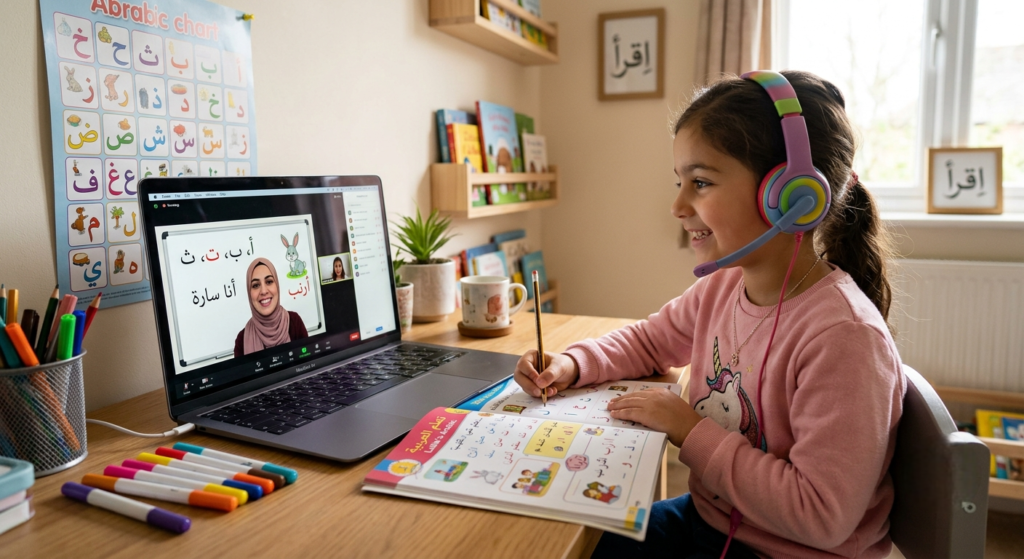
It’s a fair concern, especially after years of remote schooling and screen fatigue. Not all screen time is the same, though — the important distinction is between passive and active screen time. A well-run Arabic lesson looks much closer to a video call with a teacher than to watching a show or scrolling a feed. Your child is speaking, answering questions, listening, and interacting throughout the lesson. They’re not simply staring at a screen; they’re using it to communicate and learn.
Will my child actually speak and read Arabic, or just recognize a few words?
That largely comes down to instruction quality. Programs built around live interaction, a structured curriculum, and consistent practice give children real opportunities to develop speaking and reading skills. Gamified apps can help reinforce vocabulary, but on their own, they tend to build word recognition rather than genuine conversational ability.
What about family dialect versus Modern Standard Arabic (MSA)?
Many families speak a regional dialect at home — Egyptian, Levantine, Gulf — and wonder whether learning MSA will conflict with that. In practice, the two complement each other. MSA provides a strong foundation for reading, writing, and formal communication across the Arabic-speaking world, while the family’s home dialect remains the natural language of everyday conversation. Some programs can also take a dialect-informed approach when that better matches a family’s goals.
Still have questions? A free trial class is the easiest way to experience the learning process for yourself and find your answer.
🎁 Try a Free Class — No Payment. No Commitment.
You do not need any prior experience. Whether you are a child taking your first steps, a teen building real communication skills, or an adult learning at your own pace — with the right guidance, anyone can start speaking Arabic in a natural and enjoyable way, from day one.
Signs Your Child (or You) Is Making Real Progress
Language learning rarely happens in one dramatic leap. Progress tends to appear in small, encouraging moments: a child recognizing a letter without help, answering a question they couldn’t answer weeks earlier, or suddenly using an Arabic phrase on their own. Here’s a general idea of what to expect over time.
At 1 month: Your child may begin recognizing the Arabic alphabet and basic sounds, remembering a handful of common words and greetings, and growing more comfortable with the teacher and lesson routine.
At 3 months: You may notice your child forming simple sentences and answering basic questions such as “How are you?” or “What’s your name?” Reading short, simple words should also start to feel more familiar.
At 6 months: With consistent practice, many children can hold short conversations about familiar topics, read simple sentences with growing fluency, and speak with more confidence and less hesitation.
Every child progresses at a different pace, and these milestones are guidelines, not deadlines. A child’s age, prior exposure to Arabic, learning style, and consistency all affect how quickly they move forward. What matters most is regular practice — a child who attends lessons consistently and keeps using Arabic between classes tends to build lasting skills faster than one who attends sporadically, regardless of natural aptitude.
What About Adult Learners?
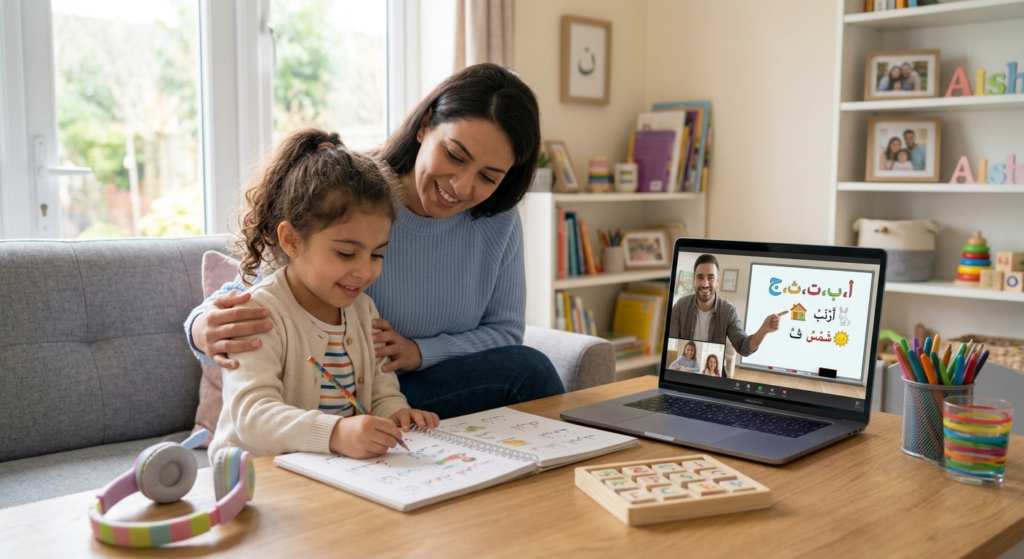
Learning Arabic doesn’t have to stop with the kids. Plenty of parents end up learning alongside their children, while others start separate lessons of their own. Learning together can be a great way to make Arabic part of the family’s everyday life.
The same core principles apply to adults: regular exposure, interaction, and consistent practice. Adults often move faster through reading and grammar since they can build on existing literacy and study skills. Speaking can take more deliberate practice, though, since self-consciousness and fear of mistakes sometimes hold adults back more than kids. The upside is real: adults are just as capable of making meaningful progress, and learning alongside your child can turn Arabic from a lesson they attend into a language your family shares.
Tips for Making Online Arabic Learning Succeed at Home
The lesson itself is only part of the process. What happens at home matters too, and a few simple habits can help your child get more out of online Arabic lessons.
Build a routine. Language learning rewards consistency far more than intensity. Choose a regular day and time for lessons — a predictable weekly routine helps your child settle into the habit and know what to expect.
Stay involved, without hovering. Sit in occasionally, or ask your child to teach you a word they learned. Simply asking how the lesson went can be enough. Small gestures like these signal that the language matters beyond the screen, without turning into pressure.
Minimize distractions. Set up a quiet space for lessons, away from siblings, TV, and other screens. Even a well-taught lesson can be hard to follow if your child is distracted by a video game or another tab.
Reinforce lightly between lessons. A few minutes of review can make a real difference. Try an Arabic song, revisit new words, or label everyday objects around the house in Arabic. These small habits keep the language present throughout the week instead of confined to a single class.
Instruction quality matters, but so do these home habits. Children who use Arabic regularly and enjoy the process tend to remember more of what they learn and keep building their skills.
Conclusion
So, can kids really learn Arabic online? Yes. When lessons are live, structured, and consistent, online learning can be a genuinely effective way for children to build real Arabic skills. The screen itself isn’t the problem — passive, disconnected screen time is. With the right approach, online lessons turn screen time into active learning and meaningful interaction.
A qualified teacher, a clear curriculum, regular practice, and a supportive home routine can help your child learn to read, speak, and understand Arabic, not just recognize a few words on a flashcard. The key is choosing a program that gives children plenty of chances to listen, speak, interact, and practice.
Ready to see the difference for yourself? Reserve your free trial class today—no obligation, just a real Arabic lesson.
Frequently Asked Questions
Does more screen time for Arabic lessons hurt my child? Not when the time is active rather than passive. A live lesson with a teacher involves talking and responding, unlike watching a video or scrolling.
Will my child actually learn to speak and read Arabic, not just recognize a few words? Yes, with the right approach. Live interaction, a structured curriculum, and consistent lessons give children regular chances to practice speaking and reading. Passive apps can help with vocabulary, but they aren’t enough on their own to build real speaking skills.
Does learning Modern Standard Arabic conflict with our home dialect? No. MSA provides the formal reading and writing foundation, while the home dialect remains the language of everyday family conversation. The two work together and give children a broader understanding of Arabic.
How long does it take to see progress? Every child learns at a different pace, but with consistent lessons, many children recognize letters and basic words within the first month, form simple sentences by three months, and hold short conversations about familiar topics by six months.
Can adults learn alongside their kids? Yes. Adults can learn Arabic alongside their children or take separate lessons. They often move faster through reading and grammar but may need more practice to build speaking confidence — and learning together can make Arabic a natural part of family life.
🎁 Try a Free Class — No Payment. No Commitment.
Your child’s first class is completely free. See the teaching style, meet the instructor, and watch your child’s reaction — before making any decision at all.
Many parents tell us the free trial was the moment everything clicked — for them and for their child.
Written by the Arabic Learning Specialists at Lingua Arabia Academy — providing live online Arabic classes for kids, teens, and adult beginners worldwide. Visit us at linguaarabia.com