If you’ve been searching whether Arabic is difficult for your children to learn, you’re probably picturing a new alphabet, unfamiliar sounds, and a script that runs the “wrong” way. It’s easy to see why Arabic might feel intimidating at first.
And that concern is perfectly reasonable. Arabic does come with some challenges but those challenges do not mean your child cannot learn or enjoy learning it.
Children learn languages differently from adults. Through listening, repetition, play, and everyday interaction, they naturally pick up new sounds, patterns, and words. With the right teacher and approach, what first looks unfamiliar can quickly become something they recognize and understand.
In this guide, we’ll explore what makes Arabic challenging and how to make learning it easier and more enjoyable.
Is Arabic Hard for Kids? The Short Answer
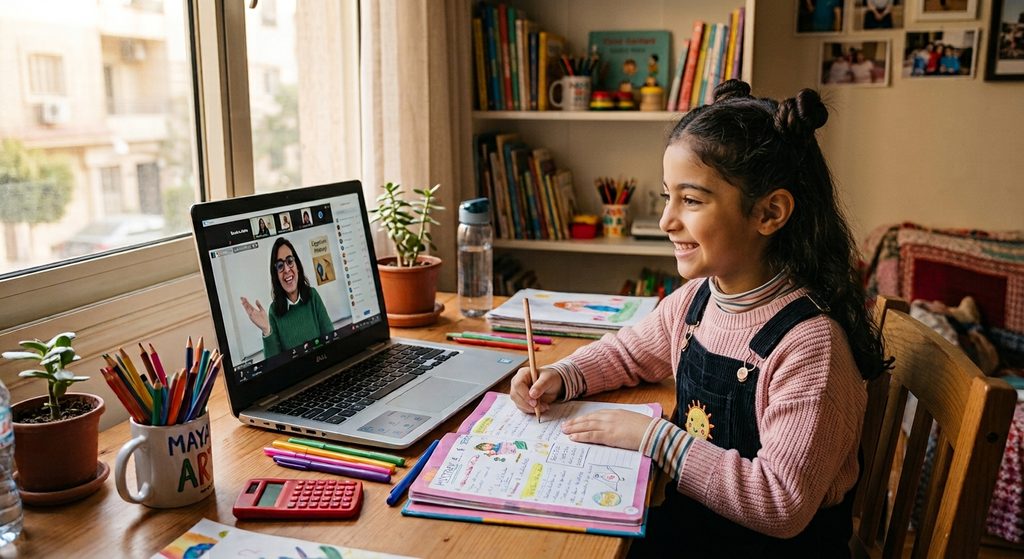
Yes, Arabic has some features that can make it challenging. But for children, learning Arabic can be much more manageable than parents often expect.
Arabic’s reputation for difficulty comes mostly from how adults learn. Adults may rely on rules, memorization, and translation, while children learn naturally through sounds, repetition, stories, songs, games, and meaningful interaction, the same way they picked up their first language.
So when you ask, “Is Arabic difficult for children to learn?” it helps to ask another question: difficult compared with what, and taught how?
Arabic has real challenges, but with age-appropriate teaching and regular practice at Lingua Arabia Academy, your child’s first experience with Arabic does not have to feel like a struggle. The right teacher can turn unfamiliar letters, sounds, and words into small challenges your child can actually enjoy.
Curious how your child would do? See for yourself in a free trial class with a native-speaking teacher. No payment. No commitment. Just try it!
🎁 Try a Free Class — No Payment. No Commitment.
You don’t need any prior experience, and neither does your child. Whether they’re taking their first steps in Arabic or ready to build real conversation skills, the right teacher makes starting simple and enjoyable, from the very first class.
Why Arabic Has a Reputation for Being Difficult
Before we talk about why children can learn Arabic successfully, it helps to be honest about what may feel difficult at first.
A new script, written from right to left. Arabic doesn’t use the Latin alphabet, and it is read and written from right to left. For a child who is used to English, this takes some adjustment, but with regular exposure, the direction quickly becomes familiar.
Letters change shape depending on position. An Arabic letter can look different at the start, middle, or end of a word. The letter ب (bā’) for example, shifts shape depending on where it sits. It feels unusual at first, but children tend to treat it like a pattern-matching game rather than a memorization task.
Some sounds don’t exist in English. Letters like ق (qāf), ح (ḥā), and ع (ʿayn) have no direct English equivalent. They can take extra listening and speaking practice. Children can benefit from hearing these sounds regularly and having a teacher guide them as they learn to reproduce them.
Short vowels are often left unwritten. Everyday Arabic text skips short vowel marks, which can make reading difficult at first. Beginner materials can use vowel marks as a helpful stepping stone until children become confident enough to read without them.
Formal Arabic differs from spoken dialects. Modern Standard Arabic, as used in books and media, differs from the Arabic spoken in different regions and communities. This difference can be confusing if not stated clearly, so children benefit from knowing what they are learning and where they will use it.
None of these challenges are small. But none of them are impossible either, especially with the right teaching approach.
Why Children Have a Natural Advantage
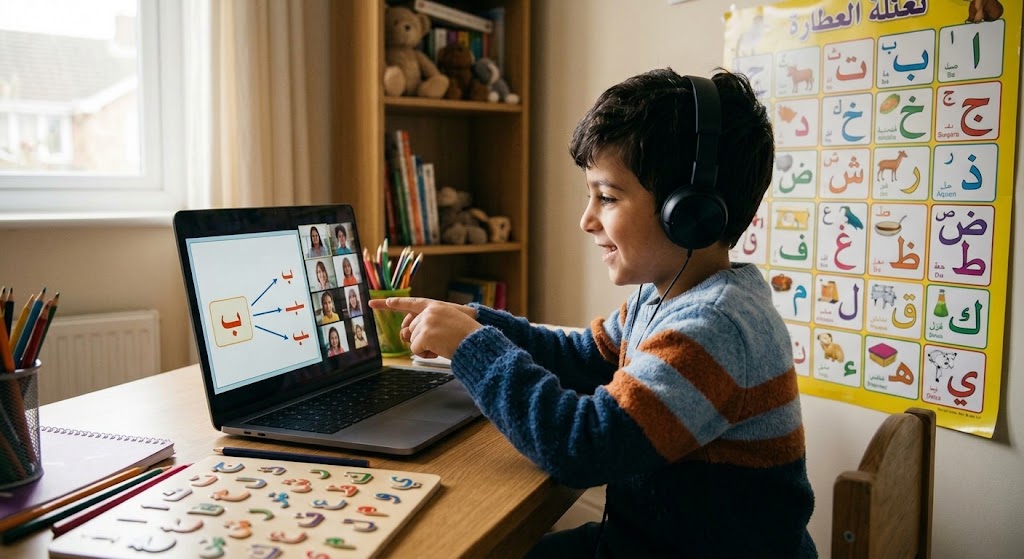
Children aren’t simply “better at languages” in every way. But some of their natural learning habits can work in their favor when they start Arabic.
They imitate new sounds more easily. Children can hear a new sound, copy it, and try again without overthinking it. Regular listening and gentle correction can make unfamiliar Arabic sounds feel more natural.
They’re less afraid of getting it wrong. Adults often freeze up over pronunciation mistakes and can become self-conscious, worried about sounding silly or mispronouncing a word. Children are usually more comfortable experimenting. That willingness to try and make mistakes gives them more opportunities to improve.
They learn through play, not memorization. Songs, stories, games, pictures, and activities can make language practice active and engaging. Instead of memorizing letters, a child might recognize them while matching cards, playing a game, or following a story.
A new alphabet can feel like a puzzle. Twenty-eight unfamiliar letters may seem overwhelming to a parent, but children can enjoy discovering which shape matches which sound. How those letters are introduced makes a difference.
The best time to start depends on your child’s age, attention span, and goals. Our guide to the best age to start learning Arabic explores what learning can look like at different ages, from early childhood through the pre-teen years.
What Makes Arabic Easier Than Parents Expect
Once you look beyond the unfamiliar script, some features of Arabic can make learning more manageable than parents expect.
There are only 28 letters. That’s close to English’s 26, and far simpler than writing systems like Chinese or Japanese, which require memorizing thousands of individual characters.
Arabic is mostly phonetic. Once a child learns the vowel marks, most words are read exactly as they’re written. English, by comparison, has many exceptions — “though,” “through,” and “tough” don’t rhyme, despite looking like they should. Arabic rarely creates that kind of confusion.
The root system makes vocabulary predictable. Most Arabic words are built from three-letter roots. From ك-ت-ب (k-t-b), you get كِتَاب (kitāb), meaning “book,” and كَاتِب (kātib), meaning “writer.” Recognizing these patterns can help children see connections between words as their vocabulary grows.
Beginners start with vowel-marked texts. A common worry parents have is that Arabic words can look difficult to read without vowel marks. Children can use appropriately vowelled materials while developing their reading skills, then gradually move toward texts with fewer marks.
Everyday vocabulary comes fast. Common words for family, food, and objects around the house tend to stick quickly, giving kids an early sense of progress they can actually use at home within the first few weeks.
Arabic is easier with the right teacher. Our native-speaking instructors at Lingua Arabia Academy turn letters, sounds and words into games your child will look forward to. Try a live class together for free.
🎁 Try a Free Class — No Payment. No Commitment.
You don’t need any prior experience, and neither does your child. Whether they’re taking their first steps in Arabic or ready to build real conversation skills, the right teacher makes starting simple and enjoyable, from the very first class.
Common Challenges by Age, and How to Handle Them
Arabic can feel different at different ages. Your child’s age affects both what they find challenging and how they learn best. What works for a 6-year-old can bore a 12-year-old, and what challenges a teen barely registers for a younger child.
| Age group | Common challenge | What helps |
|---|---|---|
| 5–7 | Short attention spans | Short, visual lessons focused on letters and sounds |
| 8–12 | Connected, right-to-left writing | Guided practice paired with everyday vocabulary |
| Teens | Grammar and real conversation | Dialogue-based lessons that build toward fluency |
For the youngest learners, the goal isn’t mastery — it’s comfort. Short activities with letters, sounds, pictures, and simple words keep learning manageable and enjoyable.
Once kids reach 8 to 12, attention spans stretch, and this is where connected writing becomes manageable with steady, guided repetition. Teens, meanwhile, respond best when lessons feel like real conversations rather than drills.
The pattern is simple across every age: the right lesson is not necessarily the longest one. What matters is giving your child an appropriate challenge, enough repetition, and room to build confidence.
How Lingua Arabia Makes Arabic Approachable for Kids
This is where the right learning environment can make a real difference. At Lingua Arabia Academy, we built our teaching path around exactly the challenges above, so nothing your child faces is left to chance.
Children move through a clear sequence: script first, common vocabulary, conversation, and then cultural context. This gives them a strong foundation without asking them to manage everything at once. A child doesn’t move to conversation before the script feels comfortable, and they don’t sit through grammar before they have real vocabulary to use it with.
Our classes run live, twice a week, with native-speaking teachers who know how to make Arabic feel playful rather than intimidating. Families can choose groups of three or one-on-one sessions, with children placed by age and level so the pace matches their needs.
If your child falls in the 5–12 age range this guide focuses on, our Kids Program is built specifically around these age bands and challenges, with lesson plans tailored to a child’s level of readiness. That means they can learn at a pace suited to their current abilities instead of being expected to follow a one-size-fits-all lesson.
5 Simple Ways Parents Can Help at Home
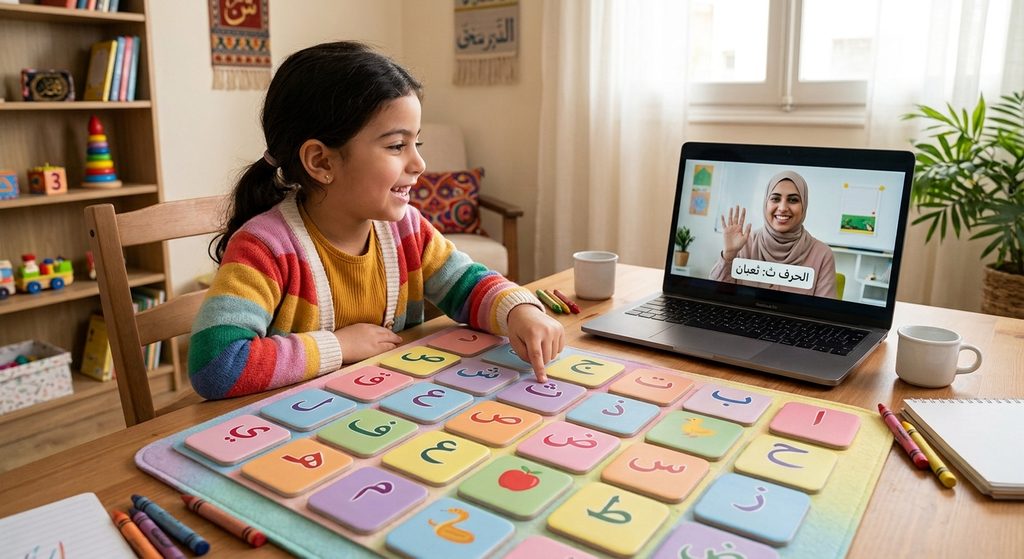
You don’t need to speak Arabic yourself to support your child’s progress. A few small habits can make Arabic part of everyday life between classes.
- Label household objects in Arabic. A few sticky notes on doors, furniture, or the fridge turn daily life into passive practice without any extra effort from you. Seeing the same words repeatedly can help your child connect Arabic words with things they already know.
- Play Arabic songs or cartoons. Choose age-appropriate Arabic content and let your child hear the language outside class. Songs and short cartoons can make listening feel natural rather than like another lesson.
- Practice a few letters in 5-minute bursts. Five minutes of focused practice can be easier to maintain than a long study session. Let your child trace letters, match shapes, or identify sounds.
- Celebrate small wins. Recognizing a new letter, reading a word, or remembering a phrase is progress. Encouragement can help your child associate Arabic with achievement rather than pressure.
- Keep a steady class routine. Regular exposure gives children more chances to revisit what they have learned. A consistent routine is often easier to maintain than occasional attempts at intensive practice.
Frequently Asked Questions
How long does it take a child to learn Arabic? There is no single timeline. Progress depends on age, starting level, goals, and how consistently they practice. Early milestones may include recognizing letters, understanding familiar words, and using simple phrases. More advanced reading and conversation naturally take longer and develop gradually.
Can my child learn if we don’t speak Arabic at home? Yes. Many of our students come from non-Arabic-speaking households. Regular live classes with a native-speaking teacher provide the exposure, correction, and conversation practice your child needs, regardless of what language is spoken at home. You can also support them through simple activities at home without needing to know the language yourself.
Should my child learn Modern Standard Arabic or a dialect first? Most children’s programs, including ours, start with Modern Standard Arabic. It’s used in books, media, and formal settings, and it gives your child a strong foundation before branching into any regional dialect later on.
Are online classes effective for young children? Yes, especially with live, interactive teacher-led sessions rather than pre-recorded videos. Real-time interaction keeps young learners engaged, corrects mistakes immediately, and holds their attention in a way passive content simply can’t match. A teacher can respond to your child’s answers, correct pronunciation, use visual activities, and adjust the pace in real time.
What age is best to start learning Arabic? There’s no single “right” age. Younger children have some advantages, but older children and teens can also progress well with the right structure and support. Our best-age guide covers what to expect at each stage in more detail.
Conclusion: Arabic Is a Challenge Your Child Can Enjoy
So, is Arabic difficult for children to learn? It has real challenges, from an unfamiliar script and sounds to differences between formal and spoken Arabic. But these challenges become much more manageable when children learn at an appropriate pace, practice consistently, and have a teacher who knows how to guide them.
The hardest part is often simply getting started and that’s the part that we can make easy for you and your child. Your child doesn’t need to master Arabic overnight. They simply need a good place to start.
Give your child a confident start in Arabic. Book a free trial class and meet your child’s teacher. No payment. No commitment. Just try it!
🎁 Try a Free Class — No Payment. No Commitment.
You don’t need any prior experience, and neither does your child. Whether they’re taking their first steps in Arabic or ready to build real conversation skills, the right teacher makes starting simple and enjoyable, from the very first class.
Native-speaking teachers • Small groups or one-on-one • Placed by age and level.
Written with insight from our team of native Arabic-speaking teachers at Lingua Arabia Academy, each experienced in working specifically with children and teens.